Monday, March 19, 2012

How Does a Lender Evaluate Your Borrowing Ability?

Check this out, give you the basic on home loans, have a great day, Sindy

If you are thinking about buying a home, one of the first things you should do is go to a lender to get pre-approved. This will determine how much money you can borrow on a mortgage. This will also help you filter your home search by sale price, which will narrow your choices within your financing range.
So how does a lender evaluate — called underwriting — and determine how much you can borrow? It involves the three C’s: Credit, capacity and collateral!

Credit or FICO Score

The first item a lender will review is your credit profile, also known as your credit score or FICO score. This can range from 350 – 850. This is where all the decisions you’ve made in the past regarding will be reflected, such as:
  • How much debt you have outstanding
  • How much debt you have outstanding as a percentage of open credit accounts
  • How much debt you have in the different types of credit accounts (credit cards, car loans, school loans, etc.)
  • How well you’ve paid your bills over the years
Lenders used to allow much lower credit scores for borrowing purposes, but they’ve gone up the past few years. You need, in general, at least a 640 FICO score to borrow on a loan. The optimal score is 740-760 or above. The lower your score, the higher your interest rate and points on your mortgage loan.

Capacity or Income

If you pass the FICO score test and the lender says you are creditworthy, the next item you will be evaluated for is your “capacity.” Capacity means that based on the lender’s allowed maximum percentage debt to your gross income, less all of your other debt payments, how much do you have available for a housing payment? It also has to be stable income, such as $65,000 per year for two years in a row.
Per the chart, you can generally have your total mortgage payment, less other debt payments, be up to about 35% to 40% of your gross income. In the chart the bank took 35% of this borrower’s $6,000 gross monthly income and subtracted out other debt payments to get a maximum allowed housing payment of $1,750. And that $1,750 equates to about a $225,000 house with a $200,000 mortgage (this means you will need to put down a downpayment of $25,000 to buy the $225,000 house) per the bottom of the chart.

Collateral or the Property

If you’ve got the credit, and the capacity, you only need one more piece and that’s the collateral. This is the easiest part. You will pay the bank and they will order an independent appraiser to determine a market value of the property. And the lender will lend you up to a certain percentage of that value (or purchase price whichever is lower) like 80% loan to value (LTV) or maybe 90% LTV or maybe up to 96.5% LTV. This depends on the bank and the loan program in which you qualify. So even if your income qualifies you for a higher loan amount, the MOST any one bank will lend you on any particular property is up to their maximum allowed loan to value percentage on that property.
That’s it! If you’ve got credit, and capacity, go out and find the collateral!
Leonard Baron, MBA, CPA, is a San Diego State University Lecturer, a Zillow Blogger, the author of several books including “Real Estate Ownership, Investment and Due Diligence 101 – A Smarter Way to Buy Real Estate.” Read useful tips for real estate buyers in his blog, Making Smart and Safe Real Estate Decisions. See more at ProfessorBaron.com.

Thursday, March 15, 2012

2012: Year Of The Great Housing RECOVERY!

THE HOUSING RECOVERY IS HAPPENING NOW! We are sticking with our prediction that 2012 will be the best real estate market in the last 5 years….and that housing has hit bottom!
The housing recovery is clearly here.. the recovery will be slow and (mostly) steady. Home by home, street by street…neighborhood by neighborhood. Expect the clearly and full recovery process to take 3-5 years.
More very encouraging news from the trusted folks at Realtor.com
Just the facts:
* The number of U.S. homes listed for sale fell 22 percent last month from a year earlier.
* Asking prices gained 6.8 percent due to increased demand.
* There were 1.78 million homes listed for sale in February with a median asking price of $188,000
* The median time homes spent on market dropped 9.8 percent to 111 days, indicating properties are selling at a faster pace.
“All this suggests that the market is healthier,” Errol Samuelson, president of Realtor.com, said in an interview. “You’re seeing the contraction in inventory and you’re now going into a spring market where there’s more demand.”
* Existing home sales rose in January to the fastest pace in 20 months as investors took advantage of a decline in prices and low mortgage rates boosted home affordability to record levels.
* The inventory of homes on the market fell to a 6.1-month supply in January, the lowest since April 2006, when the U.S. housing market was nearing its peak. The inventory had spiked to a 12.1-month supply in July 2010, when sales plunged after the expiration of federal homebuyer tax credits worth as much as $8,000.
* About 14 million unique visitors looked at Realtor.com in January, up 30 percent from a year earlier.
* The number of website and mobile application visitors asking for more information on properties jumped about 60 percent, on Realtor.com
* Not all causes of a shrinking inventory are positive. More than 11 million homeowners have negative equity, or owe more than their houses are worth, according to a March 1 report by CoreLogic Inc.
* The areas hit hardest by foreclosures, such as Phoenix and Bakersfield, California, had the biggest declines in listings, according to Realtor.com.
* Asking prices rose in 106 of 146 metropolitan areas. Chicago had the biggest decline in asking prices, with a 7.4 percent decrease, followed by Knoxville, Tennessee, and three California markets, Orange County, Sacramento and the Los Angeles-Long Beach area.
* Homes in Oakland, California, spent a median 32 days on the market, the fewest of any city, followed by Denver; Bakersfield and Fresno, California; and Iowa City, Iowa.

Saturday, March 10, 2012

Head to Head: Home Price Index vs. Housing Affordability Index

From our friends at ForeclosureRadar.com
Compare these two headlines:
Case-Shiller Home Price Index Ends 2011 With New Lows (February 28, 2012) *
Home Affordability Index Hits Record High (March 7, 2011) **
Throughout the housing crisis, the headlines have focused on the precipitous fall of prices and the resulting plight of homeowners who are underwater.

There is no doubt that the crisis has taken a huge financial and emotional toll on millions of families as the home price index has continued to decline – but it has also created opportunities for many first-time homebuyers, and for the investors who take the financial risk to restore distressed properties and make them available to buyers as the affordability index has risen.
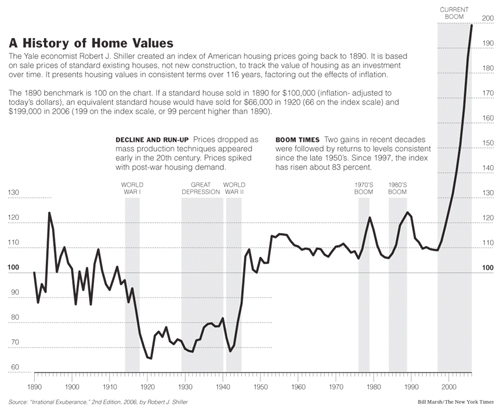
History of Home Values - The New York Times
In our September 2010 post Want to know when prices will rise? Ask the government!, we talked about the graph below and how government intervention to make homes more affordable inevitably has the opposite effect.
Comparing the rocket trajectory on the right of the graph to home values of the previous 110 years kind of puts the recent bubble into perspective. Instead of decrying plunging prices for the past five years, why haven’t we seen the following headline?
Absurdly Inflated Home Prices Get Reality Check, Prices Return to Sanity
In the past few years, the government has intervened through foreclosure moratoriums and refinancing programs in an attempt to keep home prices high rather than make them more affordable. This has not been effective, and many markets have corrected anyway – back to pre-bubble values that are in line with what people can actually afford using sensible long-term financing.
Will prices eventually make their way up to mid-2000’s peaks? Yes, over a very long time, but not really – the increase will have far more to do with the declining value of the dollar (i.e. inflation), then the actual increase in the value of housing.
Perhaps that’s a good thing. Relatively affordable housing leaves more money to spend on other things. Our children’s education, vacations, saving for retirement, etc. We understand why government wants home prices to rise – it increases tax revenues. It’s good for bankers too – higher prices equal bigger fees. But how exactly does it make a homeowner richer except on paper? Sure they can cash out if they sell, but won’t they still need a place to live?
I doubt our grandparents had the degree of fascination with home prices that we do. By and large once they purchased a home, they stayed put and paid off their mortgage around the time they were ready to retire – making that transition far easier. Baby boomers nearing retirement today have record levels of mortgage debt, and I fear that transition will not go well for them, or for our economy.
What do you think? Which is more important – high home prices or high home affordability?

*Case-Shiller Home Price Index. Designed to measure changes in the total value of all existing single-family housing stock through a complex methodology.

**NAR Housing Affordability Index.  Measures the current median income against the income required to qualify to buy a median-priced single-family home using conventional financing. (Financing with 20 percent down and monthly payments at 25 percent of the gross income.)

Saturday, March 3, 2012

Anderson Cooper Lists Fashion District Penthouse for $3.75 Million


Source: Wikipedia
A penthouse with “unparalleled style and sophistication” could only have an owner with the same sensibilities.
Anderson Cooper’s apartment is a former manufacturing space completely transformed into a sleek bachelor pad by the talk-show host and CNN news anchor. According to property records, Cooper bought the home in 2005 for $2.48 million. With his renovations completed, the two-floor penthouse was recently listed for sale in the Garment District for $3.75 million.
Filled with custom touches — from a Lustron lighting system and multi-room surround sound to aged Chambord oak floors and etched glass detailing — Cooper’s home has about 3,100 square feet of living space, two bedrooms and two bathrooms. A landscaped deck with gas grill adds an additional 1,700 square feet.
The first floor holds the master suite with attached master bath, which features limestone and teak flooring, a claw-foot soaking tub and large shower.
Up a floating staircase, the gourmet kitchen leads to an open dining area and living room with wood-burning fireplaces and views of downtown Manhattan.
Cooper is likely selling because he no longer needs the space. He purchased another converted loft, a former firehouse, in the West Village for $4.3 million in 2010 and has spent most of the year restoring the 1906 Fire Patrol #2 residence. Cooper also owns two vacation homes in the Hamptons on Long Island, including one that belonged to the late Oscar-winning screenwriter Budd Schulberg. Cooper purchased Schulberg’s home in early January 2012 for $1.7 million.
While Cooper’s work has taken him across the globe, he clearly put down roots in the area where he grew up. The son of heiress and designer Gloria Vanderbilt, Cooper spent his childhood in the Big Apple.
Cooper’s penthouse is listed by Raphael De Niro, an agent with Prudential Douglas Elliman Real Estate and son of the famous actor Robert De Niro.
Photos courtesy of Prudential Douglas Elliman Real Estate.

Friday, March 2, 2012

Entire Town for Sale in Montana for $1.4M

Got $1.4M to spare? There’s a tiny Montana village for sale

For sale: one Montana town.

The owner of Pray hopes to find a buyer who can breathe life into a small collection of buildings in five acres of the Paradise Valley. She’s willing to part with the place for $1.4 million.

“It’s a town,” said the owner, Barbara Walker. “There’s status in being able to own a town.”

The community includes a four-unit trailer park, a shuttered general store and a post office serving ZIP code 59065. Although census figures put Pray’s population at 197, all but a handful of them live in the wide-open countryside outside the town, which sits beside a scenic stretch of state highway about 30 miles north of Yellowstone National Park.

Pray is surrounded by verdant meadow between two ranges of rugged peaks. The vistas have attracted plenty of well-heeled buyers before — the actors Jeff Bridges, Dennis Quaid and Peter Fonda all have homes in the area.

Walker said she’s only selling because, after losing her husband to cancer in 2006, she’d rather not run the place alone. Since her husband’s death, Walker has been the unofficial mayor of Pray.

She collects $200 in monthly rent from each of the trailers, a bit more from the post office, and doesn’t stand on ceremony when it comes to titles. In addition to mayor, “I’m the sheriff and the garbage control and the animal control officer,” Walker said, laughing.

Since its founding in 1907, the town has gone through several different owners and one change of location, said Paul Shae, director of the Yellowstone Gateway Museum in nearby Livingston. Named after an early 20th century Republican congressman named Charles N. Pray, the town originally sat beside a railway on the opposite bank of the Yellowstone River. In 1936, Pray moved to its current spot beside Highway 540, which was once a main route for tourists headed to the national park.

When the Walkers bought the place in 1953, the town boasted a general store and bar with a petting zoo out back. Still, calling the place a town today might be a stretch.

“You can blink and miss it real easy,” Shae said.

But Walker hopes a new buyer may change that. She suggested the new owner could restore Pray’s status as a gathering spot for a community that’s spread thinly beneath the valley’s big sky. Back when Walker’s mother-in-law helped run the place, “you went to the store to find out who was getting married and who was having a baby,” she said. “If UPS couldn’t find somebody, she’d just have them leave the package at the store because eventually everyone would come by.”

As to flexibility on the price, Walker’s playing her cards close to the vest. “You gotta play like you’re playing poker,” she said. “It’s easier to go down than to go up.”